
Wake County Marriage Licenses
Marriage licenses in Wake County are handled by the Register of Deeds, not the Clerk of Superior Court. The Register of Deeds, Tammy L. Brunner, runs the office that issues licenses and keeps marriage, birth, and death certificates. The office sits downtown at 300 S. Salisbury St., Suite 1700, in Raleigh. While the license is a Register of Deeds record, the marriage ceremony itself can take place at the Wake County Justice Center, which the courts handle along with criminal matters.
The Register of Deeds main page links the marriage license application and the certificate request paths.
Start at the Wake County Register of Deeds office for licenses and certificates.
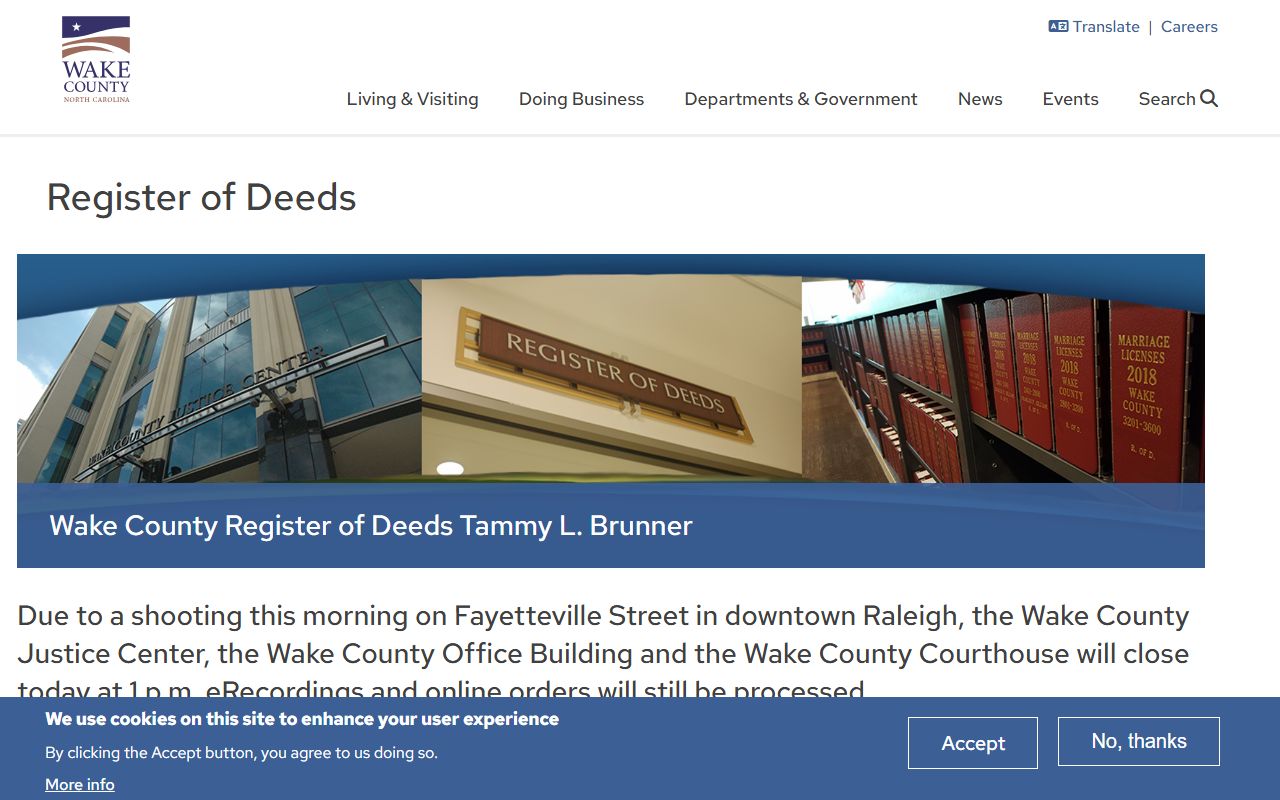
The Register of Deeds handles marriage licenses, vital records, and recorded documents.
How to Apply for a Wake County Marriage License
The application starts at the Register of Deeds. Both applicants generally need to provide identification and meet age and other requirements set by North Carolina law. Confirm the current ID rules, Social Security number requirements, and any online pre-application steps on the official Wake page before you go.
The Wake apply for a marriage license page lists the current steps.
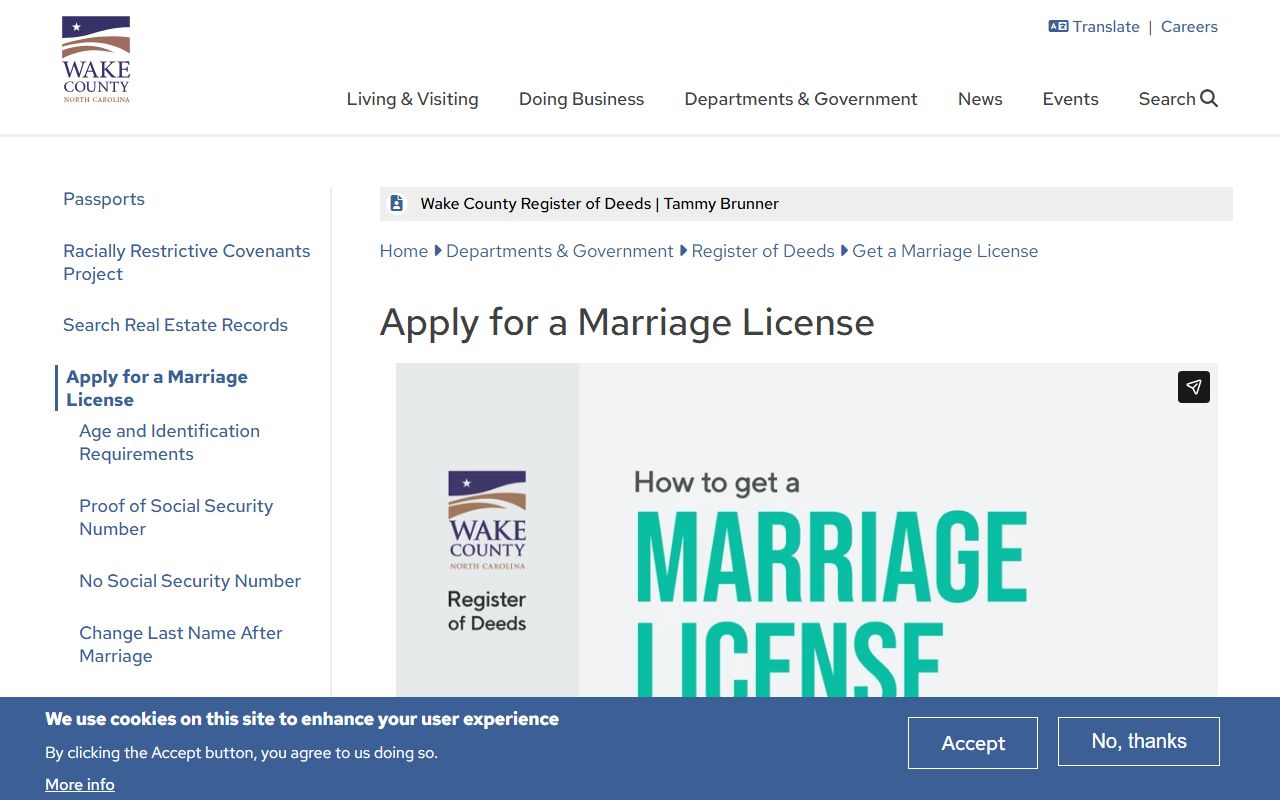
The page walks applicants through the license requirements and the in-person steps.
- Review the requirements on the Wake Register of Deeds license page.
- Gather government ID and any required documents for both applicants.
- Complete any online pre-application the office offers.
- Apply in person and pay the license fee.
- After the ceremony, the officiant returns the license for recording.
Note: A North Carolina marriage license is issued by a county Register of Deeds and is generally usable statewide; confirm current Wake instructions first.
Marriage License Application Fields
The application asks for identity and eligibility details for both applicants. The exact form fields can change, so verify them on the live Wake page. The table below lists the fields a North Carolina marriage license application commonly requests.
| Field / Requirement | Type | Required | Notes |
|---|---|---|---|
| Applicant legal names | Text | Yes | Full legal name for each applicant. |
| Date of birth / age | Date | Yes | Used for age eligibility. |
| Address | Text | Likely | Residence or mailing address. |
| Social Security number / affidavit | Text | If applicable | Verify the current North Carolina rule. |
| Government-issued ID | In person | Yes | Confirm accepted ID types. |
| Prior marriage information | Text / Date | Conditional | Divorce, death, or annulment details if required. |
| Oath / signature | Signature | Yes | Applicants may need to appear and attest. |
Payment method and the exact fee should be confirmed on the official application page.
Certified Marriage Certificates
After the ceremony, the officiant returns the completed license, and the Register of Deeds records it. From there, you can order a certified marriage certificate, which is the document people use for a name change, benefits, or proof of marriage. The office also handles birth and death certificates. A self-service portal lets you search the vital-records index, but the disclaimer notes the index is a guide and that you should try all spelling variations.
The Wake vital records page covers certificate requests.
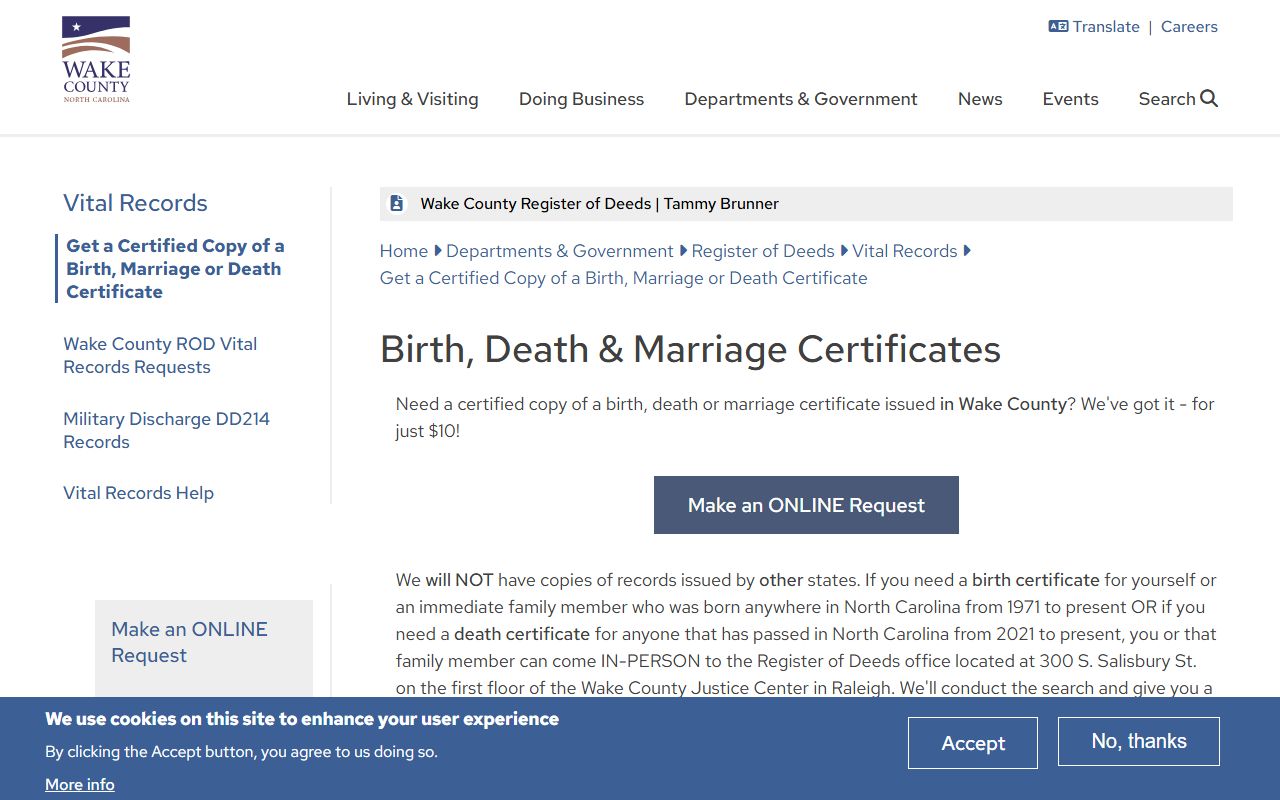
The vital-records page is where you order certified marriage, birth, and death certificates.
Office hours and the downtown location are listed on the office hours and location page.
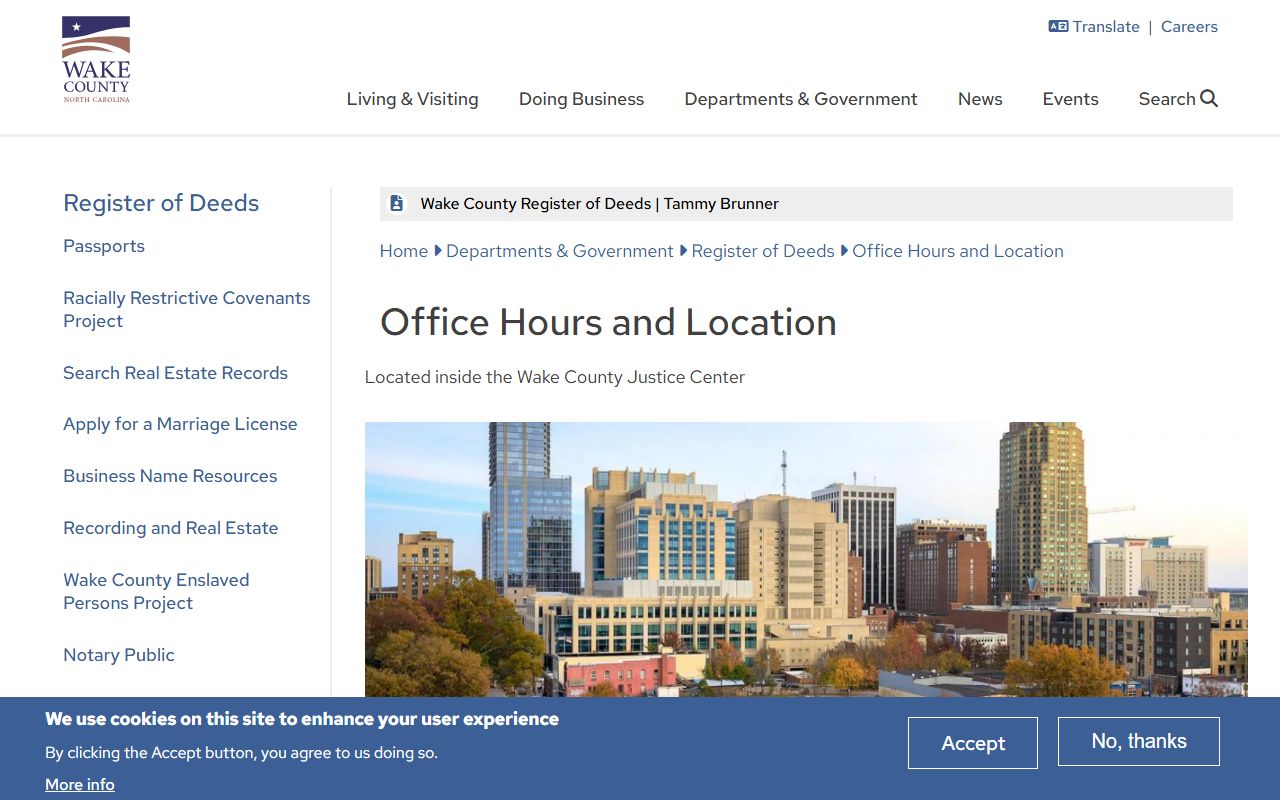
Confirm the office address and hours here before an in-person visit.
The vital-records self-service portal opens with a disclaimer you must accept before searching. It explains that the data can change without notice, that the index works like a library card catalogue, and that you should try all possible spelling variations. The county is held harmless for any damages from retrieving information online. If a name does not appear, search fewer characters and alternate spellings, then confirm a match before ordering a certificate.
Marriage Ceremonies and Officiants
The license and the ceremony are two separate steps. The Register of Deeds issues the license, but the ceremony can be performed by an authorized officiant under North Carolina law or by a magistrate. The official Justice Center page notes that marriages, along with criminal matters, are conducted at the Wake County Justice Center, so courthouse weddings happen there rather than at the civil courthouse.
After the ceremony, the officiant completes the license and returns it to the Register of Deeds for recording. Only after recording can a certified marriage certificate be issued. If you plan a magistrate ceremony, confirm scheduling and any witness requirements with the court before the date.
Marriage Versus Divorce Record Custodians
This is the distinction that trips people up. A marriage license and certificate live with the Register of Deeds. A divorce judgment lives with the court. They are different offices, different buildings, and different request paths.
| Record | Custodian | Where to Get It |
|---|---|---|
| Marriage license | Register of Deeds | Wake Register of Deeds office |
| Marriage certificate | Register of Deeds | Wake vital records |
| Divorce judgment | Clerk of Superior Court | eCourts Portal and the Clerk |
Do not call the Register of Deeds for a divorce judgment; that is a court record handled by the Clerk.
Divorce Records in Wake County
Divorce cases are District Court family matters in the Wake court system. You can find public case information through the eCourts Portal Smart Search by party name, then request a certified copy of the final judgment from the Clerk. The Wake contact directory lists a dedicated line for divorce, child custody, and pending cases at (919) 792-4125. A divorce judgment is the court document people need; a vital-record abstract is not the same as the full file.
The Judicial Branch divorce and marriage help topic explains the process and requirements.
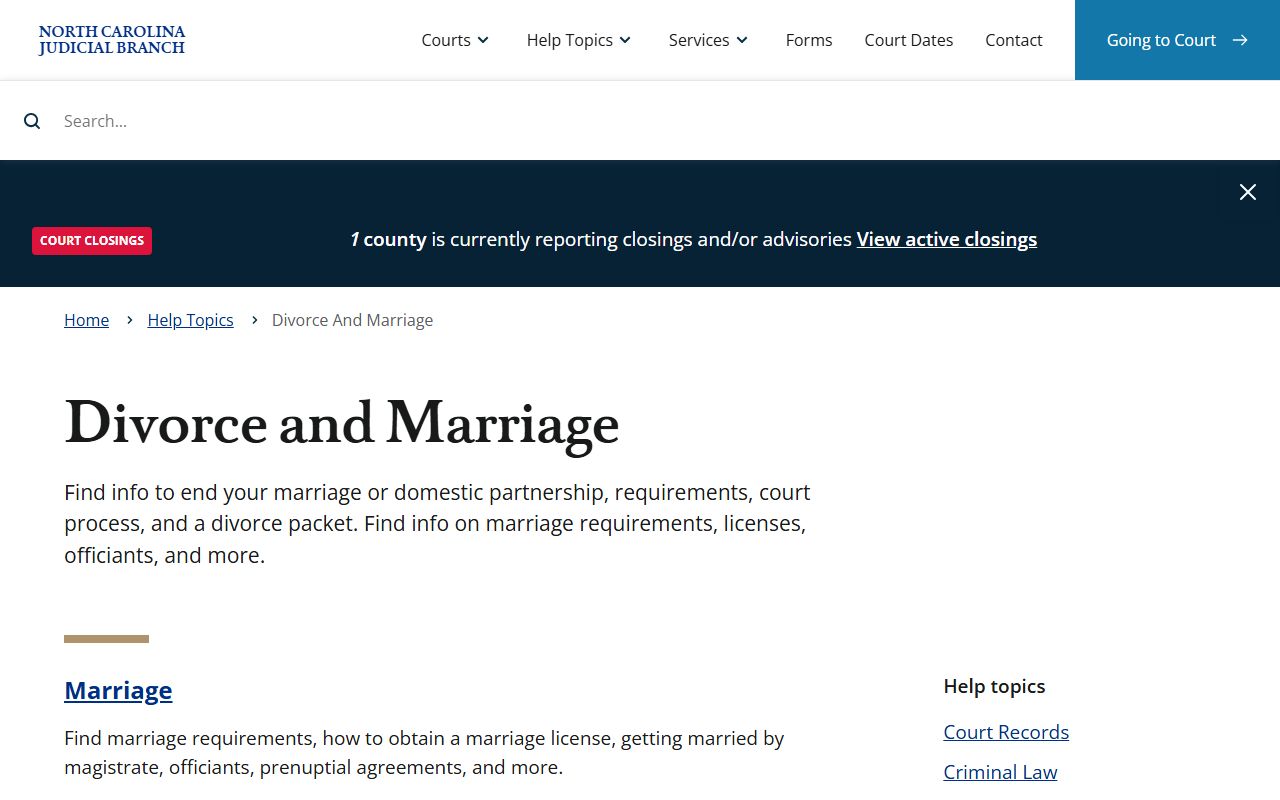
The help topic covers residency, separation, and how divorce cases move through District Court.
To search a divorce case, use the Portal fields below. A name search is the usual entry point, and a case number narrows it fast. Domestic case categories may let you filter when the Portal exposes that option.
| Field Label | Type | Required | Notes / Format |
|---|---|---|---|
| Name | Text | No | Search a spouse, plaintiff, or defendant name. |
| Case Number | Text | No | Use if you already have it. |
| Attorney | Text | No | Search by attorney of record where public. |
| County | Dropdown | No | Select Wake County. |
How to File for Divorce in Wake County
Filing for an absolute divorce follows a set order. Confirm the residency and separation requirements first, then prepare and file the right papers. Self-represented filers can use the state Guide & File service or work with the Wake Clerk where allowed.
- Confirm North Carolina residency and the separation period.
- Prepare the complaint, civil summons, and domestic cover sheet.
- File through eCourts File & Serve or with the Wake Clerk.
- Pay the filing and service fees, or request a fee waiver.
- Serve the defendant under North Carolina rules.
- Request a certified copy of the final judgment from the Clerk.
Family Court Administration and Wake's domestic forms guide custody, support, and equitable distribution filings. Wake keeps file-it-yourself domestic packets for people who are not represented by a lawyer.
Fees for Marriage and Divorce Records
Fees are set by statute or by the office that holds the record, and they change over time. The exact marriage license fee was not posted in the pages reviewed, so confirm it on the Register of Deeds page. Divorce filing costs are governed by statute and the current AOC fee schedule. The table below frames the categories rather than quoting amounts that could be out of date.
| Item | Amount |
|---|---|
| Marriage license | Set by the Register of Deeds; confirm on the ROD page |
| Certified marriage certificate | Set by the Register of Deeds |
| Absolute divorce filing | Per N.C.G.S. § 7A-308 and the AOC schedule |
| Certified divorce judgment copy | Clerk copy fee |
If you cannot afford the filing fee, you can ask to proceed with a fee-waiver petition using the appropriate court form.
Divorce Public Access Cautions
An absolute divorce judgment may be public, but related material can be sealed or redacted. Child custody details, domestic violence filings, financial affidavits, and juvenile information may be restricted. Equitable distribution files can hold detailed financial records, including affidavits and inventories. For legal name change, remarriage proof, or benefits, use the certified divorce judgment, not a vital-record abstract. For the full case file and certified copies, see the Wake County court records page and the Clerk of Superior Court page. Keep the certified judgment in a safe place, since reordering can take time and a fee.