
How to Find Wake County Arrest Records
Recent arrests in Wake County show up first in the jail system. The Wake County Sheriff's Office runs an inmate inquiry portal that lists people currently booked into the county detention facilities. That portal is the official local source for an active arrest. For the criminal case that grows out of the arrest, the North Carolina eCourts Portal carries charges, court dates, and dispositions. Use both: the jail tool for custody, the court tool for the case.
You will get the cleanest result with a full legal name. A booking number or case number narrows it further.
- Open the Wake Sheriff inmate inquiry for current jail bookings.
- Search by last and first name, then confirm with date of birth.
- Note the booking number, charges, and custody status.
- Open the eCourts Portal Smart Search for the criminal case.
- Contact the Clerk of Superior Court for certified court documents.
Note: Jail records and court records update on different schedules, so a recent booking may not appear in the court Portal right away.
Arrest Record Versus Criminal Court Record
An arrest record and a criminal court record answer different questions. The arrest record is the Sheriff's account of a booking. The court record is the case the State files afterward. One can exist without the other, and they rarely update at the same moment.
| Point | Arrest Record | Criminal Court Record |
|---|---|---|
| Custodian | Wake County Sheriff | Clerk of Superior Court |
| What it answers | Who was booked and on what charges | Charges filed, hearings, and outcome |
| Where to search | Sheriff inmate inquiry | eCourts Portal Smart Search |
| Proves guilt? | No | Only a conviction or judgment does |
For the full case side, see the Wake County court records page; for live custody, see inmate records.
What a Wake County Arrest Record Shows
A booking record holds the basic facts of an arrest. The exact fields depend on what the Sheriff publishes, but most jail records share a common set. Sensitive items such as medical and mental health classification, security risk flags, and active investigation material are withheld.
- Name and booking number.
- Booking date and custody status.
- Charges as booked, with bond amount or type.
- Housing facility and arresting agency.
- Next court date, where published.
Charges listed at booking are accusations. They can change, be dropped, or be reduced as the case moves through court.
| Field | What It Shows |
|---|---|
| Booking Number | The jail identifier assigned at intake. |
| Booking Date | When the person was taken into custody. |
| Custody Status | Whether the person is currently held or released. |
| Charges | The offenses as booked, which may change in court. |
| Bond | The amount or type of bond set for release. |
| Arresting Agency | The Sheriff or municipal agency that made the arrest. |
The Wake County Booking Process
An arrest in Wake County usually runs through a magistrate first. Magistrates are District Court judicial officers who issue warrants, set bail, and handle the initial release decision. After arrest, detention staff create the custody record, confirm identity, inventory property, screen for medical and security needs, assign a booking number, and take fingerprints and a photo where required.
Release can follow several paths. A person may bond out, a court may change the conditions, or charges may be dropped. Bond can be secured, unsecured, or a written promise to appear. Because the jail file and the court file are separate systems, a release can post before the court docket catches up, and the reverse can happen too.
Charges Versus Convictions
This is the single most important distinction on an arrest page. A charge is what the State accuses a person of. A conviction is what a court finds after a plea or trial. An arrest record can show serious charges that later end in dismissal, reduction, or a not-guilty result. Treating a charge as proof of guilt is both unfair and, for some uses, illegal.
| Point | Charge | Conviction |
|---|---|---|
| Meaning | An accusation the State must prove | A court's finding of guilt |
| Source | Arrest, warrant, or indictment | Plea or trial verdict and judgment |
| Can change? | Yes, can be dropped or reduced | Final unless appealed or expunged |
To follow a charge to its outcome, check the disposition field on the court case in the Portal.
Mugshots and Booking Photos
A mugshot is the photo taken at booking. When the Sheriff publishes booking photos, they appear with the jail record while the person is in custody. Mugshots can come down once a person is released, and they do not prove guilt any more than the charge does. Private mugshot websites that scrape and republish these images are not official, and this site does not link them. For an official booking photo, the Sheriff's inmate inquiry is the source while the record is active.
Criminal Court Records Behind an Arrest
After an arrest, the State usually files a criminal case. District Court handles misdemeanors and infractions; Superior Court handles felonies after probable cause or indictment. The criminal court record includes the charges, first appearance, bond orders, motions, pleas, and the final judgment. The District Attorney for Prosecutorial District 10 prosecutes these cases. For the case file itself and certified copies, work through the Wake County court records page and the Clerk.
Background checks are a common reason people pull these records. Public access computers at any courthouse let you run free, non-certified criminal record searches, and the Portal does the same online.
State and Federal Criminal Records
County tools do not cover everyone. A person who moved from the Wake jail to state prison shows up in the North Carolina Department of Adult Correction offender search, which covers inmates, probationers, and parolees. Federal custody is tracked by the Bureau of Prisons inmate locator, with records from 1982 forward. The State Bureau of Investigation handles official criminal background checks and the sex offender registry. Each system answers a different question, so a complete picture sometimes means checking more than one.
For people who have left custody, the released inmates page walks through the state and federal locators in detail.
Restricted and Confidential Criminal Records
Not every criminal record is public. Juvenile delinquency and undisciplined adjudications are not public records and may not be released without a court order under N.C.G.S. § 7B-3000. Law enforcement investigative records are limited by N.C.G.S. § 132-1.4, so basic arrest facts may be public while investigative notes, informant data, and active case material are withheld. Sealed indictments and search warrants can stay closed during an investigation.
The Judicial Branch juvenile delinquency help topic explains how confidentiality works for young people in the system.
The juvenile delinquency help topic confirms these adjudications are not public.
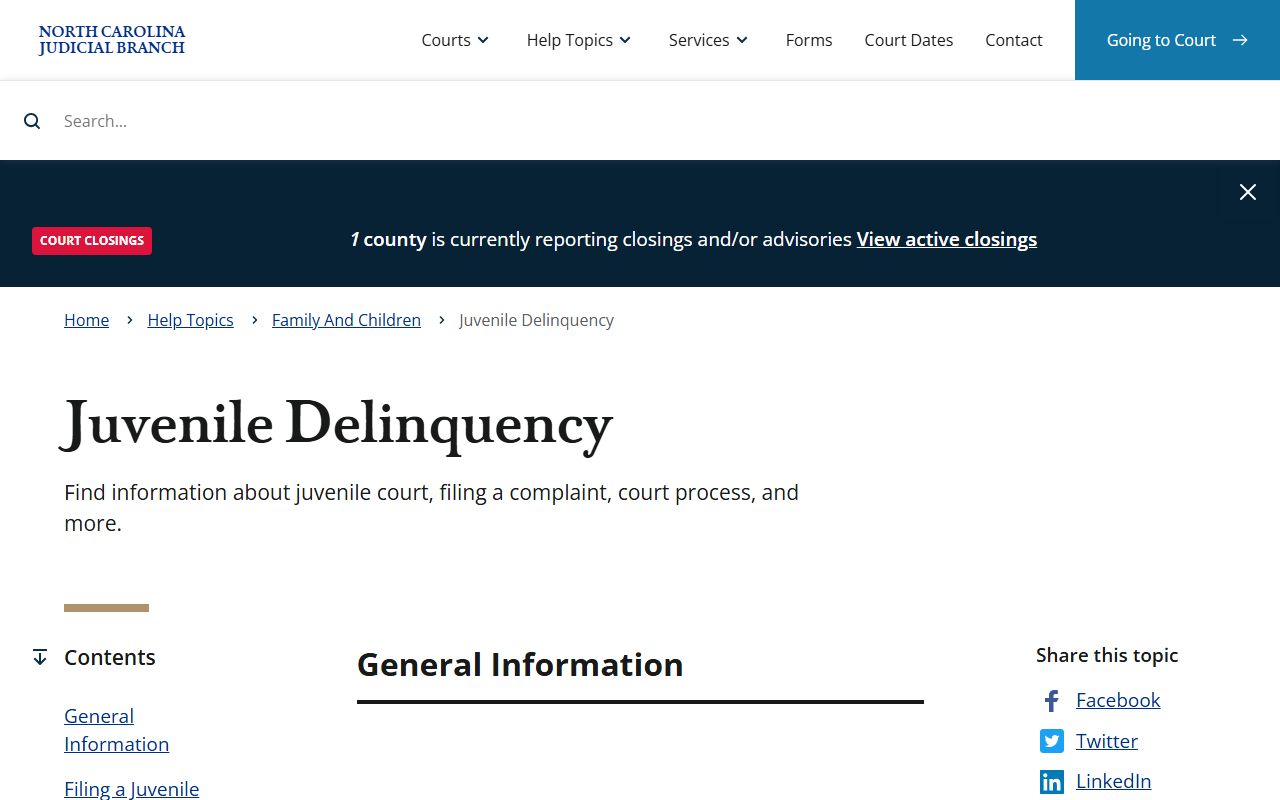
The page ties juvenile confidentiality to the statute that keeps these files closed.
That statute is N.C.G.S. § 7B-3000, which governs juvenile records.
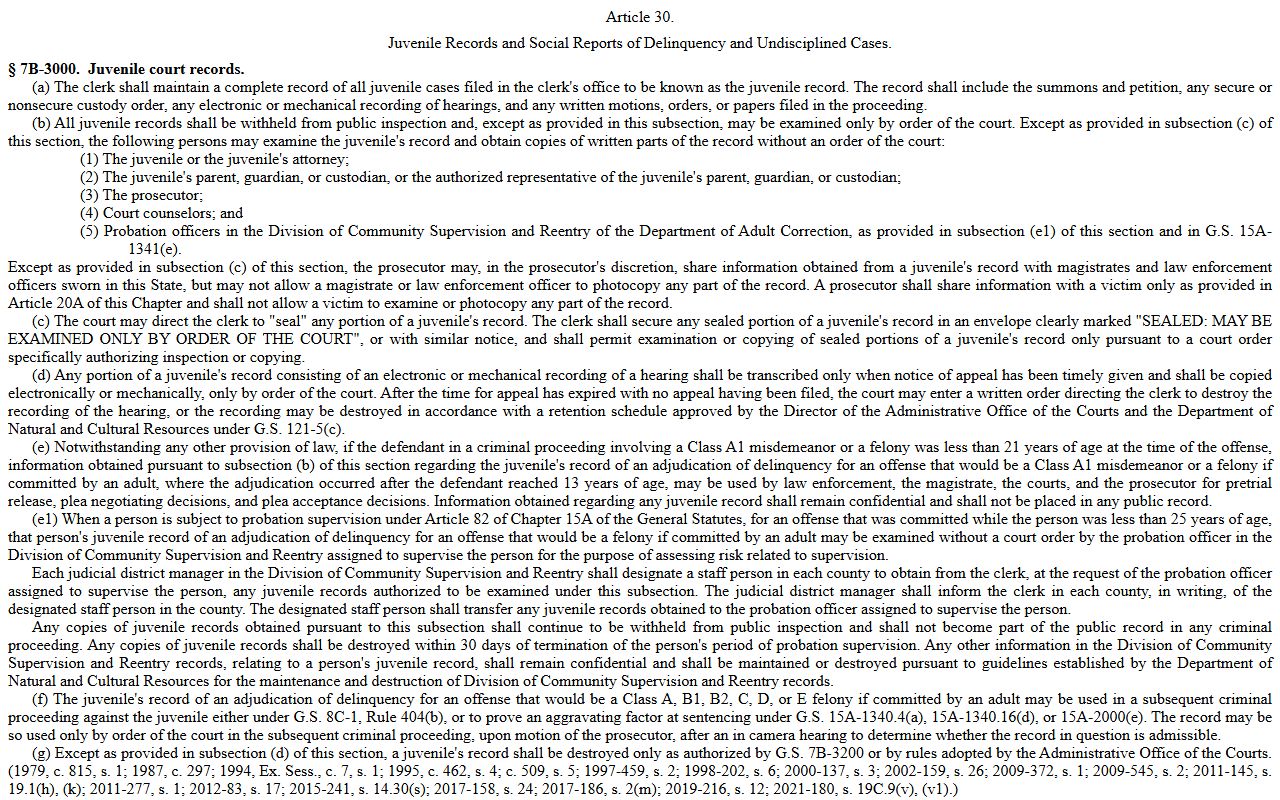
The statute spells out who may access juvenile records and under what conditions.
Expunging a Wake County Criminal Record
An expunction removes, seals, or destroys the State's record of an arrest, charge, or conviction. You file the petition with the clerk in the county where you were charged or convicted, so Wake cases go to the Wake Clerk. Eligibility depends on the statute, the charge, your age, your prior record, and how the case ended. The general filing fee is $175, though some dismissed or not-guilty petitions carry no fee unless tied to a diversion or deferred prosecution. The process can take several months because of record checks and hearing scheduling.
The Judicial Branch expunctions help topic lists the statutes and walks through eligibility.
See the expunctions help topic for the petition process and timing.
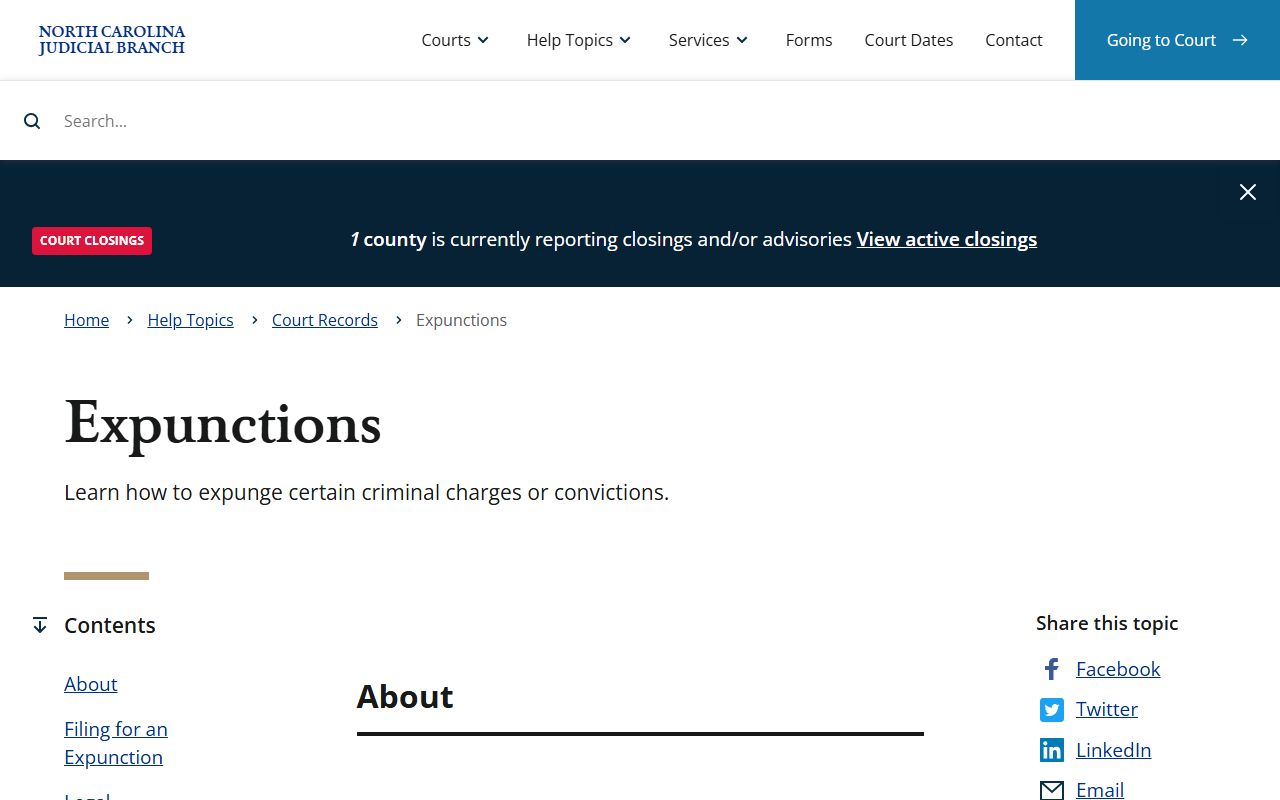
The page notes the $175 fee, the fee-waiver option, and the months-long timeline.
Misdemeanor conviction expunctions fall under N.C.G.S. § 15A-145.
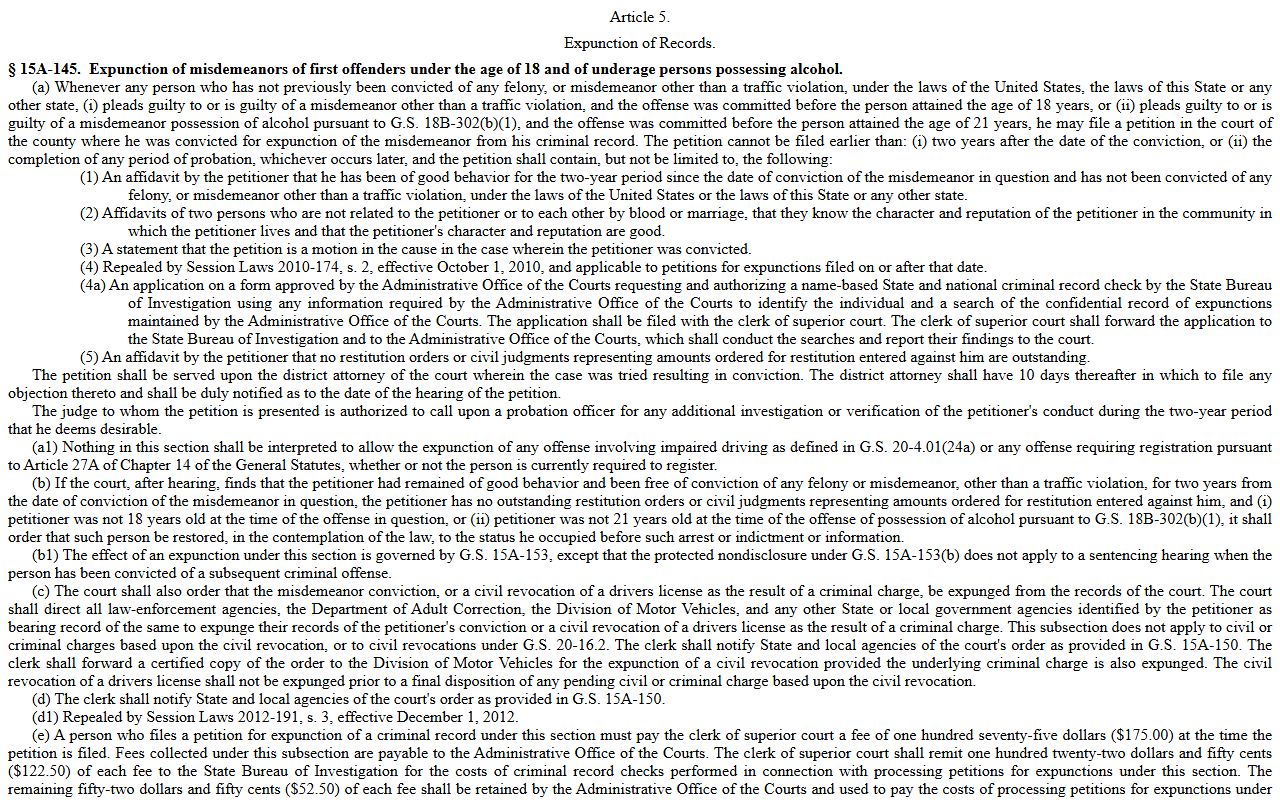
This statute sets the path for clearing certain misdemeanor convictions.
Nonviolent misdemeanor and felony expunctions follow N.C.G.S. § 15A-145.5, with waiting periods and conditions.
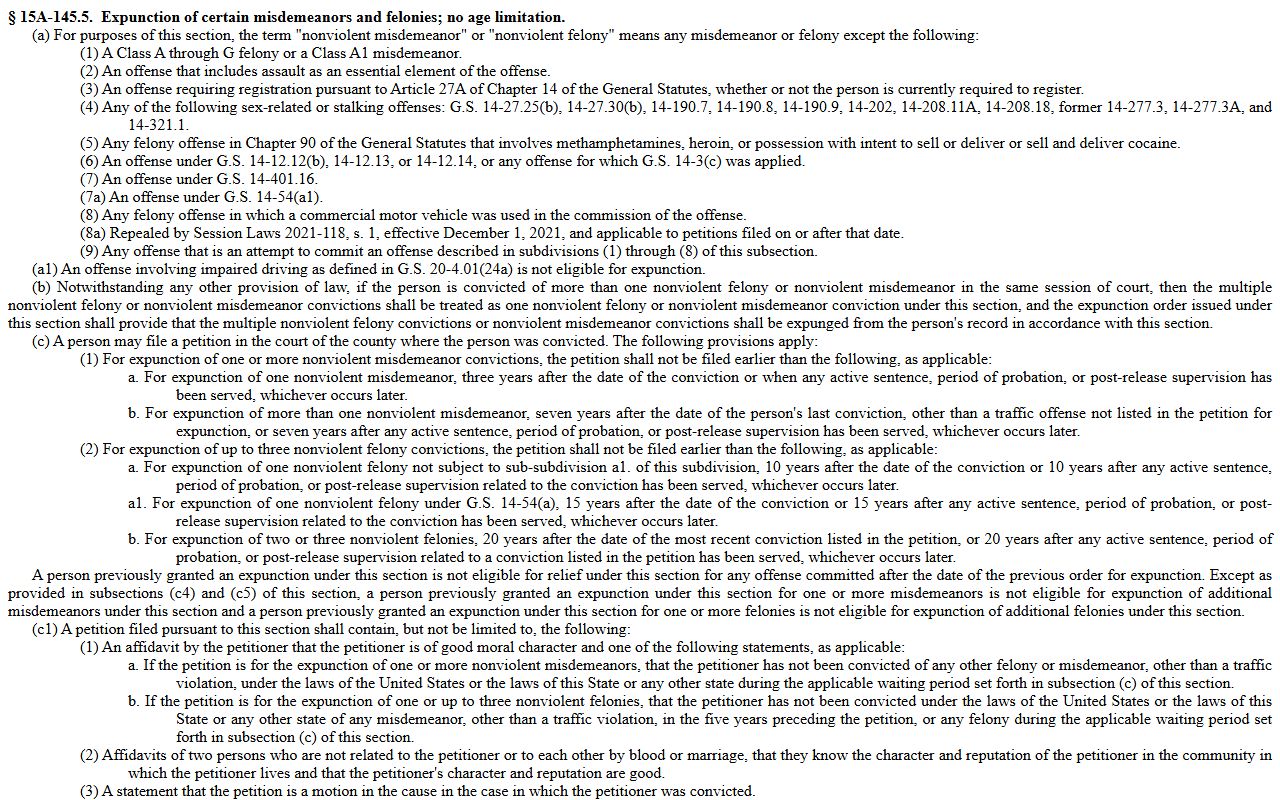
The statute covers waiting periods and the conditions for nonviolent conviction relief.
Young people have a separate path under N.C.G.S. § 7B-3200 for juvenile expunction.
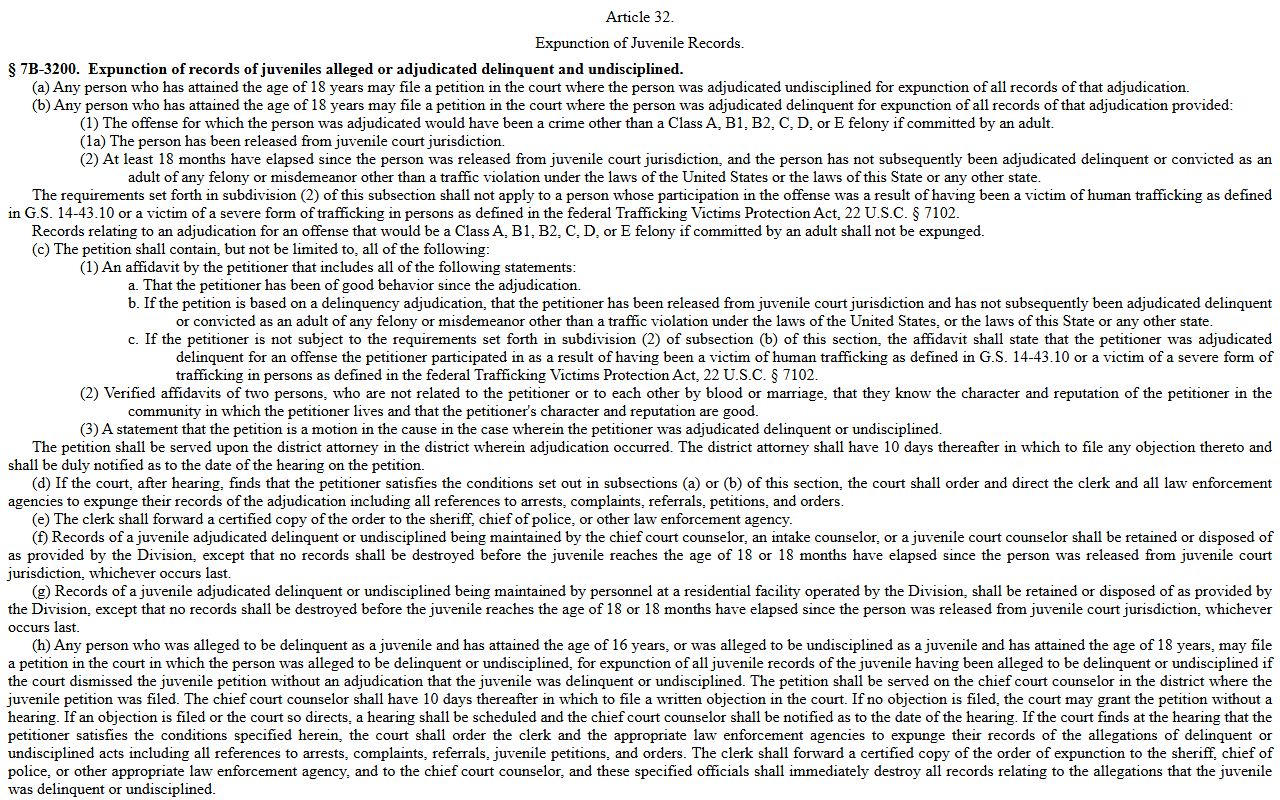
Juvenile expunction is handled apart from the adult expunction statutes.
Sealed Versus Expunged Records
People mix up these two often. A sealed record still exists but is hidden from public view. An expunged record is removed, sealed, or destroyed so the event is treated as if it did not happen for most purposes. After an expunction, a person can generally deny the event without committing perjury, though it may not erase every consequence, including some federal immigration uses.
| Point | Sealed | Expunged |
|---|---|---|
| Does the record still exist? | Yes, hidden from the public | Removed, sealed, or destroyed |
| Can you deny the event? | Limited | Generally yes, for most purposes |
| Who may still access it? | Courts and authorized parties | Narrow exceptions only |
After an order is granted, the clerk gives a copy at that time; later copies are usually not available because the files are destroyed.
District Attorney and Public Defender
The District Attorney for Prosecutorial District 10 represents the State in Wake criminal cases and prepares the criminal trial docket. A defendant who cannot afford a lawyer can ask for court-appointed counsel at first appearance. The Wake County Public Defender's Office and North Carolina Indigent Defense Services handle eligible indigent defense. For active jail custody tied to a criminal charge, the inmate records page is the place to check, and active orders for arrest are covered on the warrant records page.