
How to Search Wake County Court Records
Wake County court records are searched through the North Carolina eCourts Portal. The Portal is the statewide public system run on Tyler Technologies software, and it covers criminal, civil, special proceeding, and estate case information. The landing page has four tiles. Smart Search finds case records and case information. Search Hearings finds court dates by name, county, and date range. Make Payments handles eligible probation, parole, and some criminal or infraction balances. NC Judgment Search is an index of judgments under state law. You do not need an account to search, but the system needs JavaScript and cookies turned on.
Have a few things ready before you start. A full name helps, and a case or citation number helps more. The Portal adds a CAPTCHA challenge every five minutes for all users, so keep that in mind on a long session.
The official Wake County landing page on the Judicial Branch site links these tools and lists local court services.
The North Carolina eCourts Portal is the front door for Wake case searches.
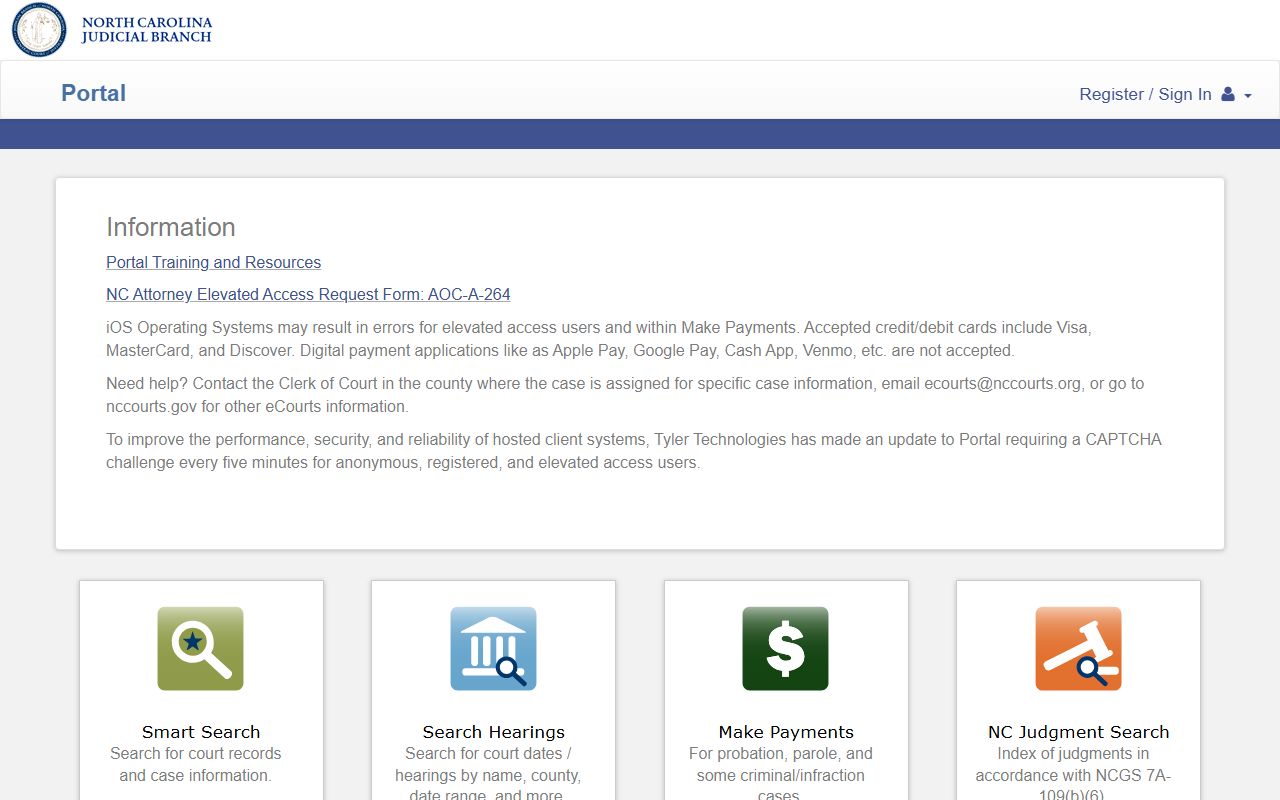
The Portal tiles let you jump straight to a record search, a court date lookup, or a payment screen for a Wake County case.
- Open the eCourts Portal and accept any usage notice.
- Pick Smart Search for case records, or Search Hearings for court dates.
- Type a party name, case number, attorney, or citation number.
- Narrow by county and select Wake County, which is District 10.
- Open a matching case to view parties, events, and hearing dates.
- Request a certified copy from the Clerk of Superior Court if you need an official document.
Note: The Portal shows case information, but certified copies are issued only by the Wake County Clerk of Superior Court.
The Wake County Judicial System
North Carolina runs one statewide court system called the General Court of Justice. It has three divisions: the Appellate Division, the Superior Court Division, and the District Court Division. There are no separate county-run trial courts here. Wake County sits in Superior Court District 10 and District Court District 10. Superior Court is the higher trial division. It hears felonies, civil cases over $25,000, and appeals from District Court. District Court hears misdemeanors, infractions, family law, juvenile cases, and civil claims under $25,000. Magistrates work within District Court and handle small claims, evictions, warrants, and bail.
Appeals from Wake trial courts go to the North Carolina Court of Appeals, and some matters reach the Supreme Court of North Carolina. The District Attorney for Prosecutorial District 10 represents the State in criminal cases.
Case flow: Magistrate / District Court › Superior Court › North Carolina Court of Appeals › Supreme Court of North Carolina
| Court | Jurisdiction | Case Types |
|---|---|---|
| District Court | Trial division, District 10 | Misdemeanors, infractions, divorce, custody, juvenile, civil under $25,000 |
| Superior Court | Trial division, District 10 | Felonies, civil over $25,000, District Court appeals |
| Court of Appeals | Appellate, statewide | Most appeals from trial courts |
| Supreme Court | Highest court, statewide | Select appeals and constitutional questions |
You can read the official breakdown on the Judicial Branch structure of the courts page, and Wake's local court services are listed on the Wake County Judicial Branch page.
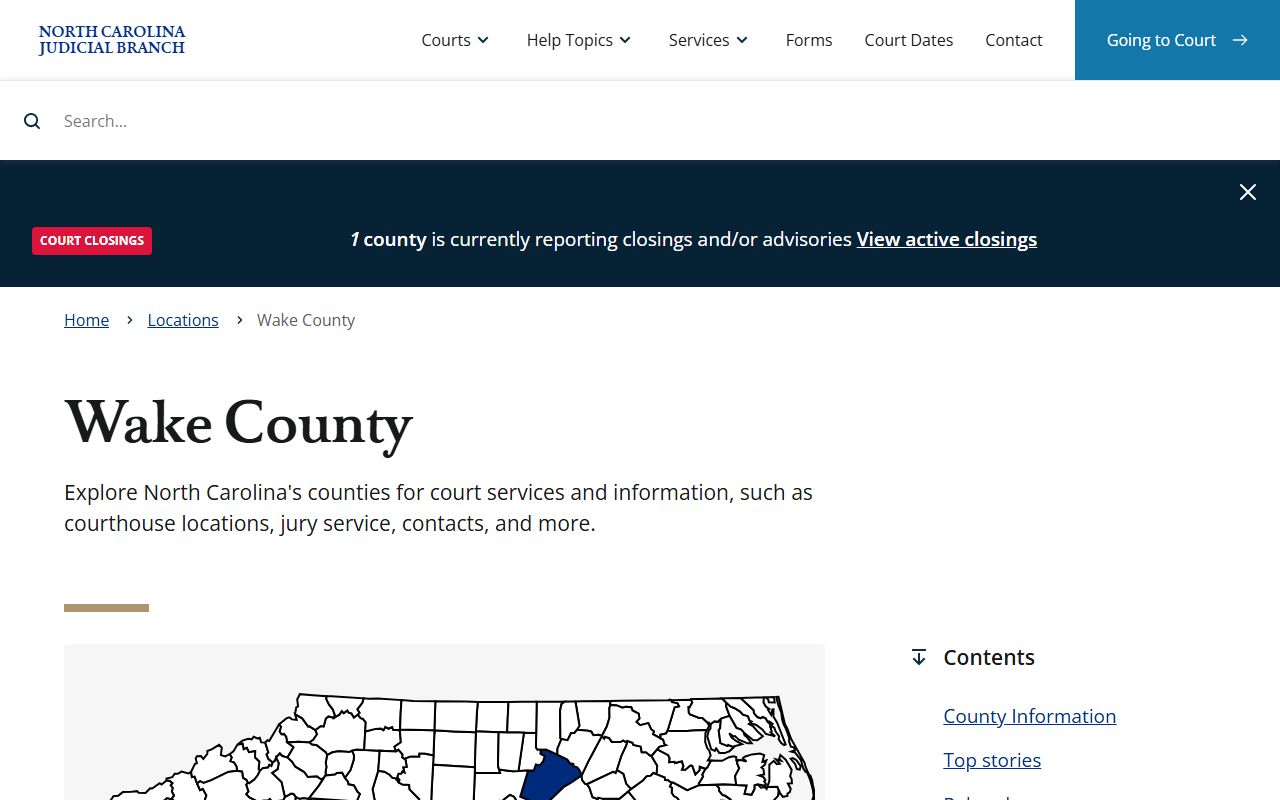
The Wake landing page points to court dates, forms, calendars, and the District 10 court offices.
Wake County Courthouses
Wake County has a clean split between two downtown Raleigh buildings. The Wake County Courthouse handles all civil matters except marriages. The Wake County Justice Center handles all criminal matters and marriages. Both are within the same government block, and both use the same main phone line. A common mistake is going to the wrong building, so check the case type first. The Register of Deeds, which keeps marriage licenses and land records, sits nearby but is a separate office from the court clerk.
The official Wake County Courthouse page and the Wake County Justice Center page list each building's address, hours, and function.
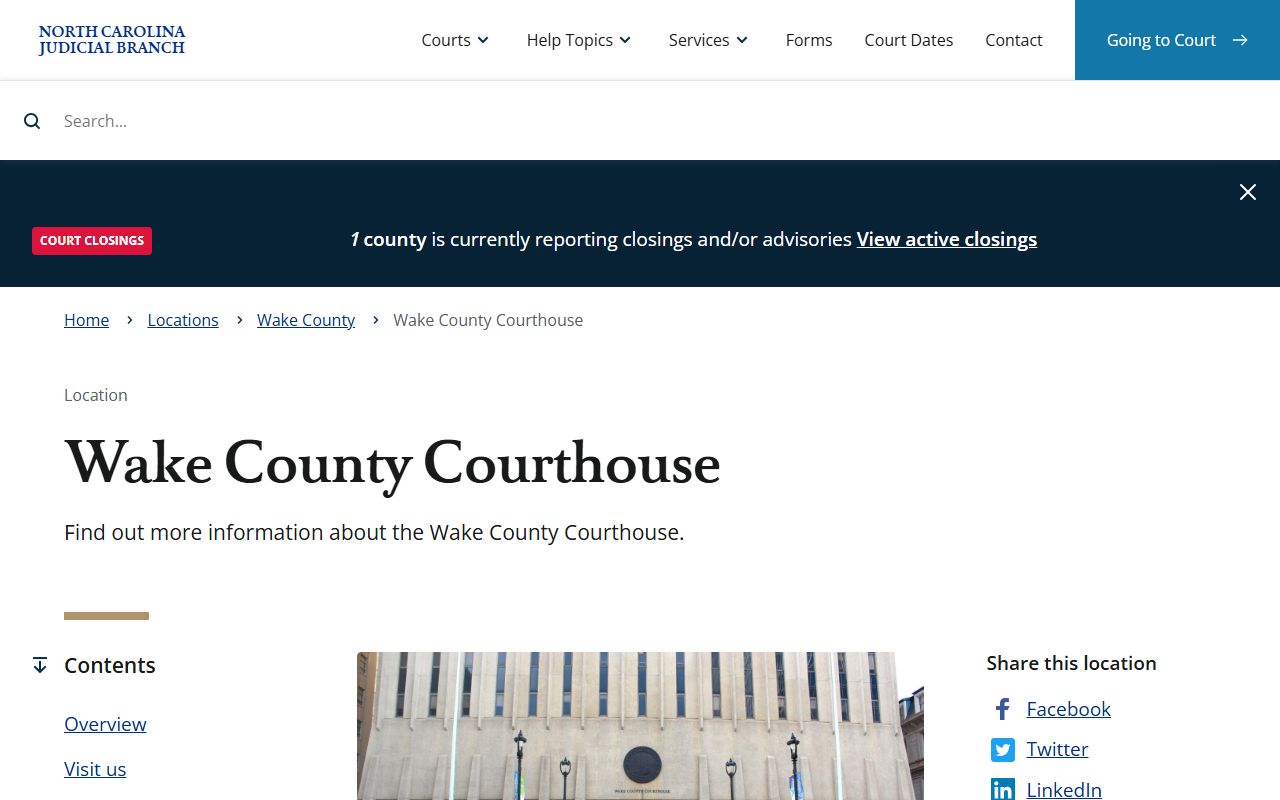
The Courthouse page confirms civil matters, except marriages, are conducted at 316 Fayetteville Street Mall.
Wake County Register of Deeds
300 S. Salisbury St., Suite 1700
Raleigh, NC 27601
(919) 856-5460
The Justice Center page is the official source for criminal court and marriage services downtown.
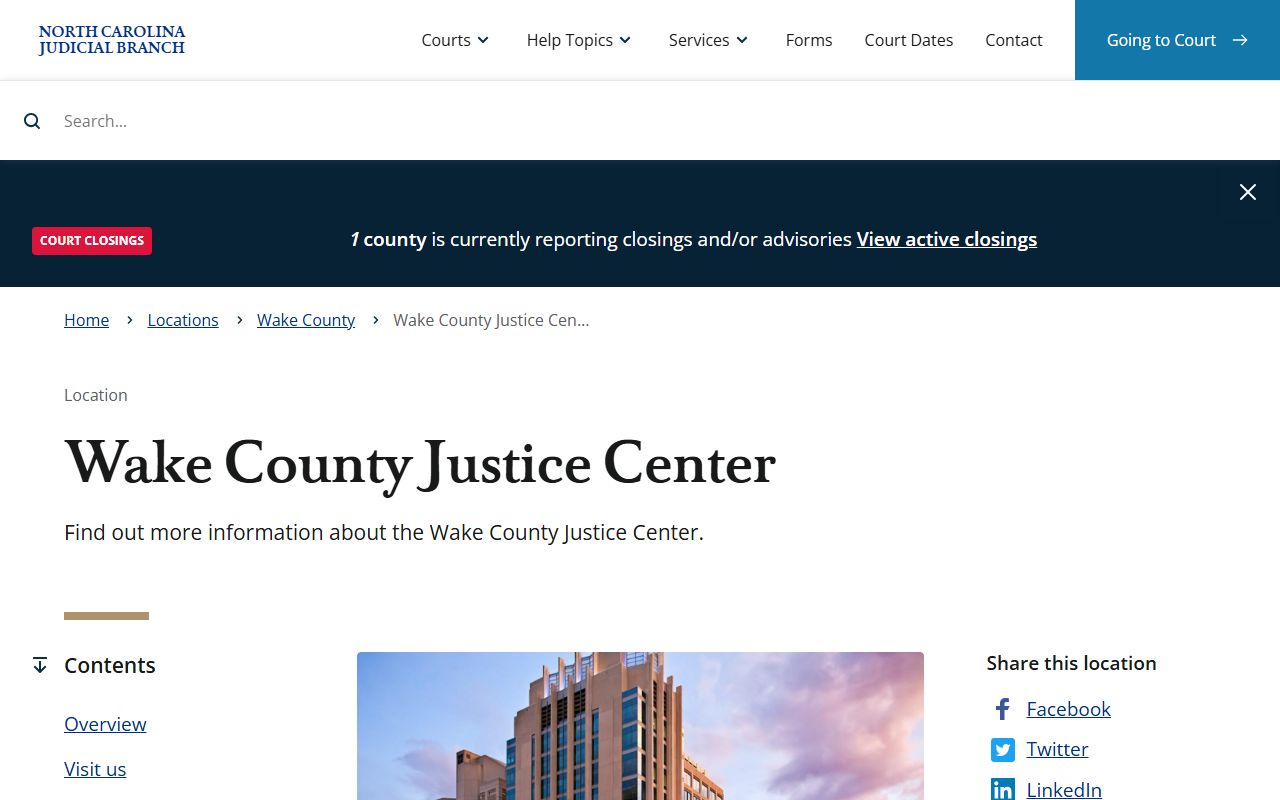
Criminal dockets, magistrates, and marriage ceremonies all run through the Justice Center at 300 S. Salisbury Street.
Types of Court Records Available in Wake County
The Wake County Court produces many record types, and each one comes from a specific division. Civil and criminal files split between the two main buildings. Family, juvenile, and estate matters run through District Court and the Clerk. Knowing which record type you need makes the search faster and tells you which clerk line to call. Some records, like juvenile and adoption files, are not open to the public at all.
The Wake contact directory groups court phone numbers by case type, which is handy in a high-volume county like this one.
- Criminal records - felony and misdemeanor cases, first appearances, pleas, and judgments.
- Civil records - complaints, answers, motions, judgments, liens, and small claims.
- Family and divorce records - divorce, custody, child support, and domestic matters.
- Probate records - wills, estates, guardianship, and special proceedings.
- Traffic records - infractions and minor offenses handled in Administrative Traffic Court.
The Wake County contact directory lists a separate phone line for each of these record groups.
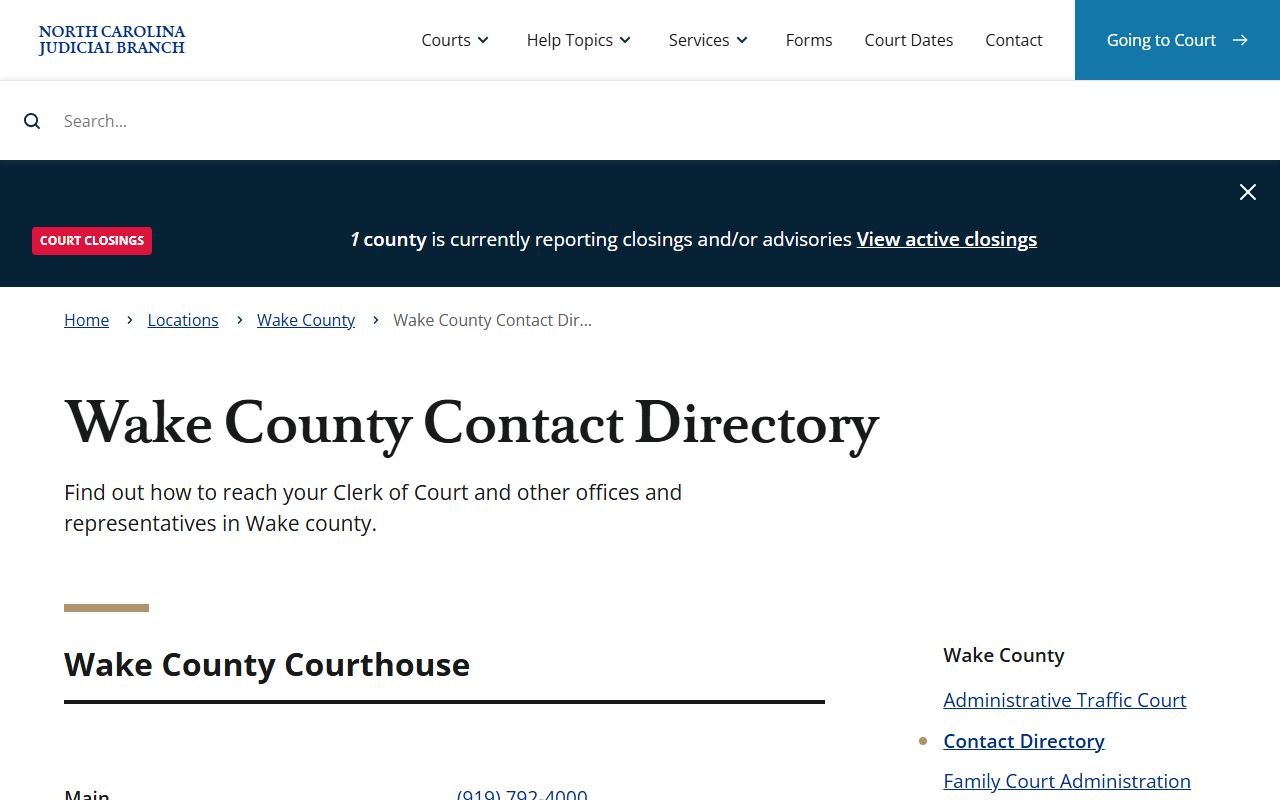
The directory routes callers to traffic, criminal, civil, estates, and special proceedings clerks by topic.
Traffic infractions are handled on their own fast calendar in Wake's Administrative Traffic Court.
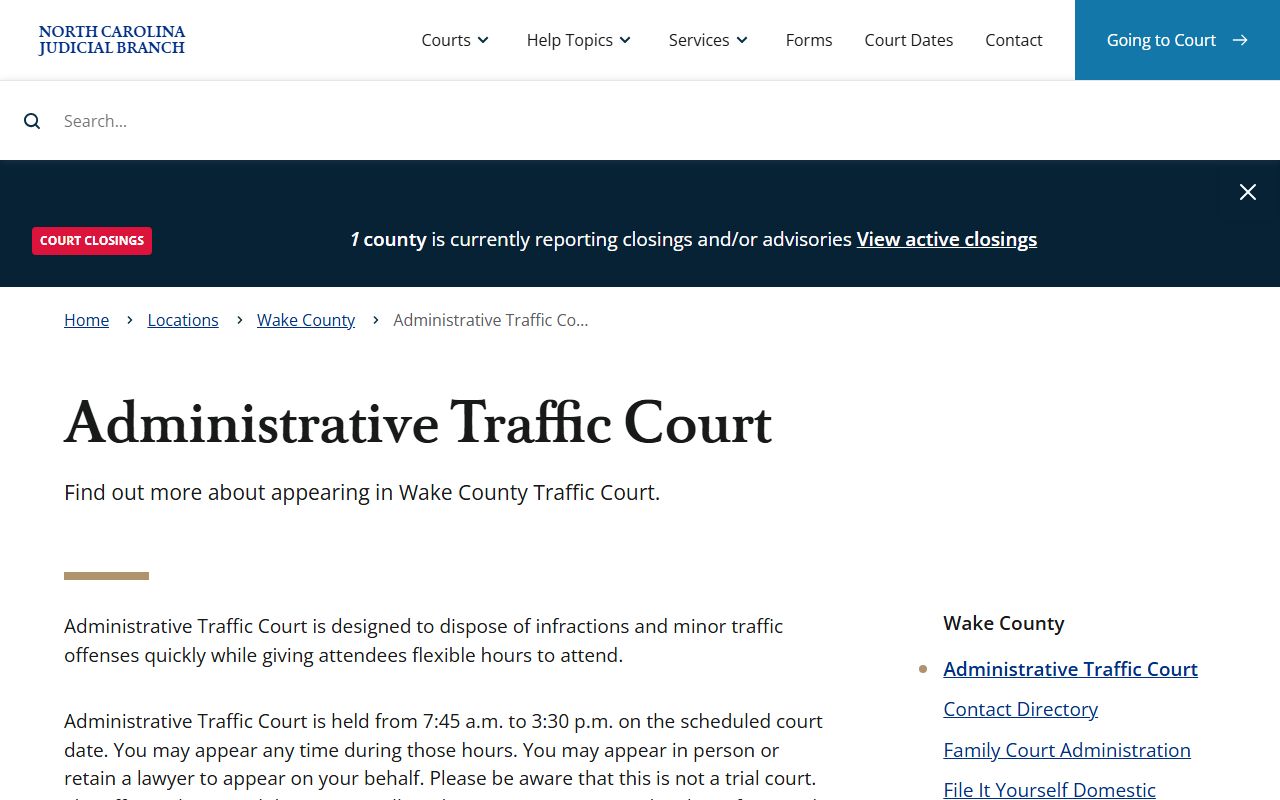
The traffic court page explains courtroom 101 hours and the sign-in process for citations.
What Wake County Court Records Show
A Wake County court record holds the basic facts of a case. The exact fields vary by division and case type, but most public files share a common set. You can expect a case number, the court and county, the parties, the charges or cause, the filing date, and a list of events. Disposition and judgment fields show how the matter ended. Sensitive items such as Social Security numbers, financial accounts, minor identifiers, and confidential addresses are redacted.
| Field | What It Shows |
|---|---|
| Case Number | The eCourts case identifier; format varies by division and case type. |
| Filing Date | The date the case was filed or initiated. |
| Parties | Plaintiff and defendant, State and defendant, or petitioner and respondent. |
| Charges / Cause | The offense, claim, or cause behind the case. |
| Disposition | The current or final outcome of a charge or case. |
| Sentence / Judgment | The court's final decision, sentence, or money judgment. |
Full field details vary, so use the Wake County court records page for a deeper look at search fields and result formats.
Public Access Laws for Wake County Court Records
North Carolina's public records law is in Chapter 132 of the General Statutes. Any person has the right to inspect public records and get copies, and agencies must allow this at reasonable times. Court records also follow court-specific statutes and confidentiality rules. The Clerk of Superior Court stays the official custodian for court files and certified copies, even when the Portal shows the case online. Police investigative records and certain case types have their own limits.
Key Statutes:
N.C.G.S. § 132-1 - defines public records broadly as materials made or received by a public agency in public business.
N.C.G.S. § 132-6 - requires custodians to allow inspection and provide copies as promptly as possible.
N.C.G.S. § 7A-109 - directs clerks to keep court records and indexes, including the judgment index.
The Judicial Branch explains the basics on its North Carolina public records law page.
Records That Are Restricted or Confidential
Not every court file is open. Juvenile delinquency and undisciplined adjudications are not public records and may not be released without a court order under N.C.G.S. § 7B-3000. Adoption records are confidential under N.C.G.S. § 48-9-102. Expunged records are removed, sealed, or destroyed, and access after an expunction is tightly limited. Domestic violence filings can have redacted addresses and identifiers. Grand jury material and sealed search warrants stay closed during an active investigation.
To view a sealed record, the usual path is a motion or petition in the case itself, not a standard public records request. The court with jurisdiction decides whether to allow access.
Specialty Courts in Wake County
Wake County runs several problem-solving and family programs alongside the regular dockets. The Adult Treatment Court is a recovery-focused model that supervises eligible defendants with substance use or behavioral health needs. Family Court Administration helps move divorce, custody, child support, and equitable distribution cases toward more consistent outcomes, and Wake keeps a full set of local domestic forms. Other listed programs include Court-Ordered Arbitration, the Child Custody and Visitation Mediation Program, the Family Financial Settlement Program, and the District Criminal Court Mediation Program. These programs can cut down on contested hearings.
Wake County Sheriff and Jail
The Wake County Sheriff's Office is led by Sheriff Willie Rowe and is the primary law enforcement agency for unincorporated Wake County. The office runs the county detention facilities, civil process, courthouse operations, and the inmate inquiry portal. Voters elect the Sheriff to four-year terms. Jail custody records are separate from court case files, even though they are linked by the same arrest.
For a current jail search, visit the Wake County inmate records page, and for active orders for arrest see the warrant records page. The official Sheriff department page is wake.gov.
Marriage, Divorce, and Probate Records
These three record types confuse a lot of searchers because they sit in two different offices. Marriage licenses and certificates are Register of Deeds records. Divorce judgments are court records kept by the Clerk. Probate of wills and estates is handled by the Clerk of Superior Court acting as judge of probate. For more, see the marriage and divorce records page and the probate records page.
- Testator
- A person who makes a will and whose estate is probated after death.
- Executor
- The person named in a will to carry out the estate, given authority by clerk-issued letters.
- Conservator
- A person appointed to manage the affairs of someone who cannot manage their own.
Wake County Court Records Fees
Court fees in North Carolina are set by statute and the current AOC fee schedule, so exact totals change over time. Public case searches on the Portal cost nothing. Certified copies and many filings carry fees collected by the Clerk. The figures below come from official sources; confirm current amounts with the Wake Clerk before you rely on them.
| Item | Amount |
|---|---|
| Portal case search | No cost |
| Expunction petition (most charges) | $175 |
| Dismissed or not-guilty expunction | Often no fee |
| Civil action / special proceeding costs | Per N.C.G.S. § 7A-308 and AOC schedule |
| Estate administration costs | Per N.C.G.S. § 7A-307, based on estate value |
| Public record copies | Actual cost under N.C.G.S. § 132-6.2 |
The Wake payment information page covers accepted payment types for court balances.
How to Interpret Wake County Court Records
Court files use shorthand that can trip up first-time searchers. A charge is an accusation, not proof of guilt. A disposition is the outcome, and a judgment is the court's final word. "Called and failed" means the defendant did not appear when the case was called, which can lead to an order for arrest. "Dismissed with prejudice" cannot be refiled; "dismissed without prejudice" can. Bond entries may read secured, unsecured, or written promise. When a result looks unclear, the safest move is to confirm it with the Clerk before acting on it.
Accuracy and Record Limitations
Online records can lag behind real events. A jail release may post before the court file updates, and a new filing may take time to appear in the Portal. Names get entered with typos, suffixes, and aliases, so a single search can miss a record. Use a case number, citation number, or date range when you can. Wake also moved onto the statewide eCourts system in 2023, so older records may have changed format.
Note: Always confirm a name, date, or outcome with the Wake Clerk of Superior Court before you rely on any online court record for a legal or financial decision.
History of Wake County Courts
Wake County is the state's capital county, and Raleigh serves as both the county seat and the state capital. The courts here are part of the statewide General Court of Justice rather than a county-built system. Superior courts are North Carolina's oldest courts, set up in 1777. A major modern change was eCourts. Wake was a pilot county and launched the new system on February 13, 2023, with Harnett, Johnston, and Lee. By October 13, 2025, all 100 counties used the same Enterprise Justice platform.
The Judicial Branch tracks the statewide rollout on its eCourts page, and Wake's local eCourts policies stay posted on the county site.
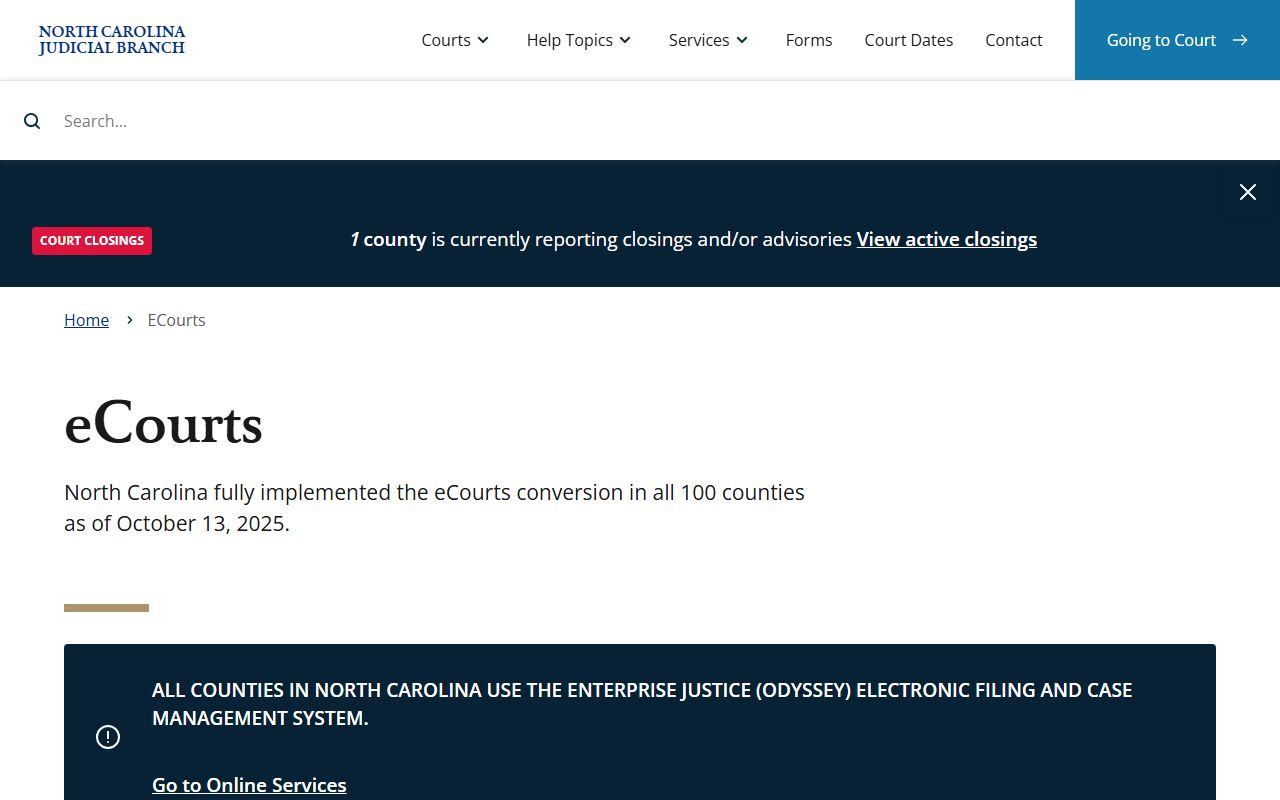
The statewide eCourts page confirms all counties now run on the same Odyssey case management system.
Self-Help and Legal Aid Resources
Wake County has strong self-help options for people without a lawyer. The state Guide & File service walks you through guided interviews to prepare court documents, with eFiling for some case types. Legal Aid of North Carolina helps eligible residents with expunction, housing, benefits, and civil matters. The NC Bar Association runs a lawyer referral service. Clerks can hand you forms and filing information, but court officials cannot give legal advice.
Start with Guide & File for guided documents, or use File & Serve for electronic filing.
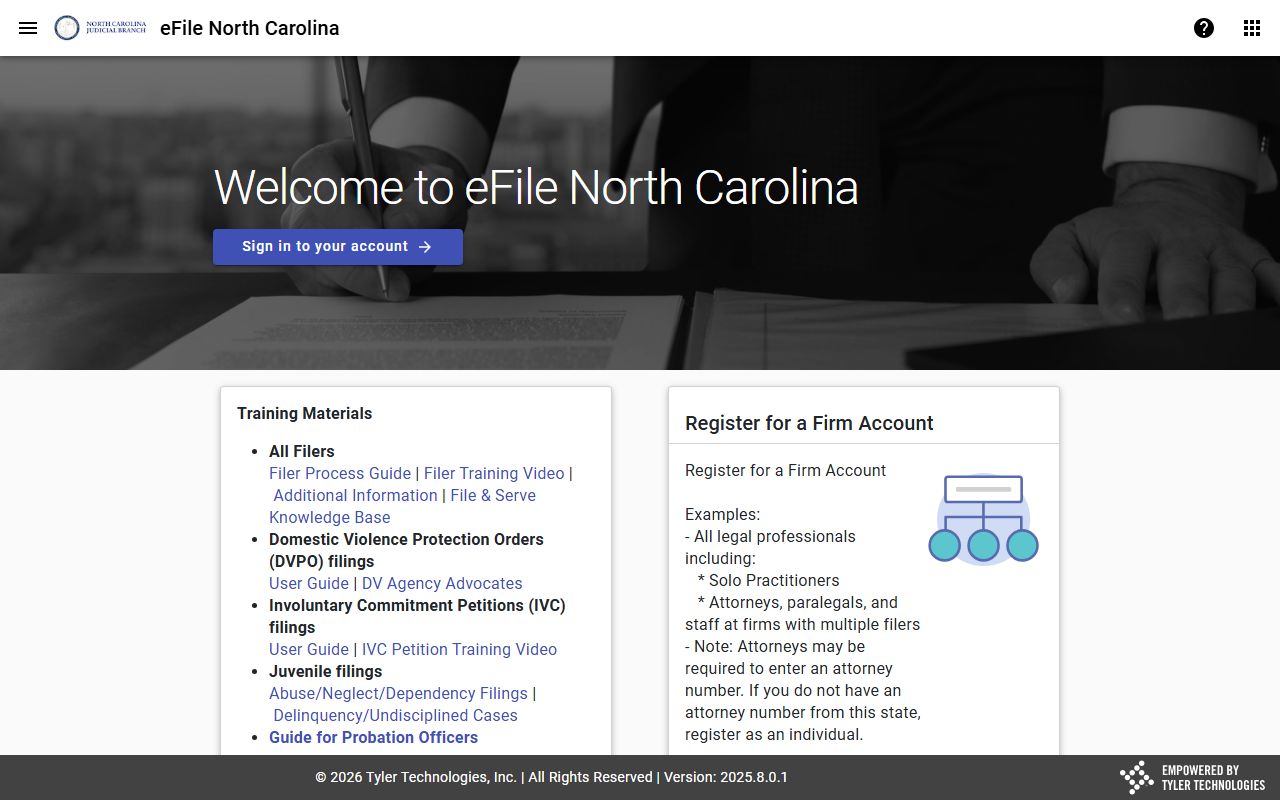
File & Serve is the eFiling system attorneys and parties use for Wake County cases.
For self-represented filers, the guided Guide & File interviews build the right forms step by step.
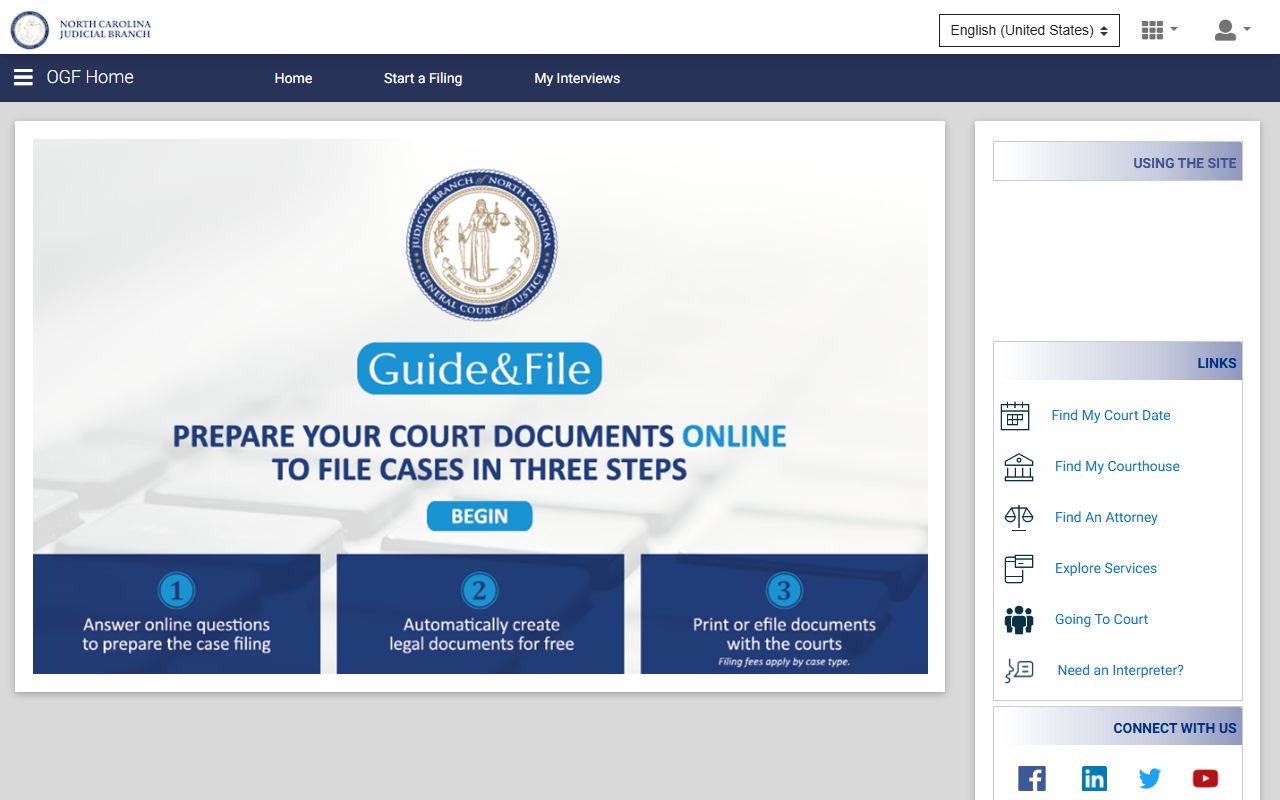
Guide & File helps pro se litigants prepare divorce, small claims, and other common filings.
Frequently Asked Questions
How do I search Wake County court records online?
Use the North Carolina eCourts Portal. Choose Smart Search for case records and Search Hearings for court dates. You can search by name, case number, attorney, or citation number, then narrow to Wake County. The Portal needs JavaScript and cookies and adds a CAPTCHA every five minutes. For certified copies, contact the Wake Clerk of Superior Court.
Which building handles civil versus criminal cases?
Civil matters, except marriages, are at the Wake County Courthouse, 316 Fayetteville St. Mall. Criminal matters and marriages are at the Wake County Justice Center, 300 S. Salisbury St. Both share the main line (919) 792-4000 and open Monday through Friday, 8:30 a.m. to 5:00 p.m.
Are eCourts Portal records official certified copies?
No. The Portal gives you case information and lets you locate a case, but the Clerk of Superior Court issues the certified copies people need for legal, benefit, or immigration purposes. Find the case online first, then ask the clerk for the certified document.
More on the Wake County Court Records FAQ page.